Showing posts with label Vladimir Ashkenazy. Show all posts

Tuesday, 22 January 2013

HIGHLIGHTS FROM THE 3RD HONG KONG INTERNATIONAL PIANO COMPETITION 2011

Chairman of the Jury Vladimir Ashkenazy with the 1st Prizewinners of all three editions of the Hong Kong International Piano Competition. From left, they are Jinsang Lee (Korea, 2008), Ilya Rashkovskiy (Russia, 2005) and Giuseppe Andaloro (Italy, 2011). With them are the organisers of the competition, Dr Anabella Levin-Freris and Dr Andrew Freris of the Chopin Society of Hong Kong.
The Prize-giving Ceremony and Gala Concert on  31 October 2011 featured a recital by the three 1st prizewinners. Here they are performing the Waltz and Romance for 6 hands by Rachmaninov.

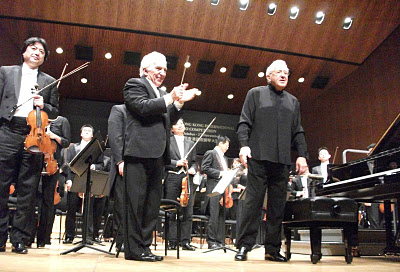
The Gala Concert on 2 November 2011 was a "Mother of all piano concerto concerts", featuring four piano concertos performed by members of the competition jury with the Hong Kong Philharmonic Orchestra conducted by Vladimir Ashkenazy. Here the maestro applauds Cristina Ortiz who gave a glittering performance of Shostakovich's Piano Concerto No.2.

Russian juror Tigran Alikhanov played Prokofiev's Third Piano Concerto.
The Hungarian-born Peter Frankl was a revelation in Liszt's Second Piano Concerto.

The ageless Gary Graffman only performs works for the left hand these days. On this evening, he put the polish on Ravel's Left Hand Piano Concerto.

Chamber music also figured in the Gala Concerts. On 1 November 2011, Pascal Rogé performed Ravel's Piano Trio in A minor on this fiery red Steinway with violinist Andrew Haveron and cellist Pierre Doumenge.

Monday, 21 January 2013

A Few Words with DR ANABELLA LEVIN-FRERIS, Honorary Secretary of the Chopin Society of Hong Kong (Part I)


Dr Andrew Freris and Dr Anabella Levin-Freris, at the conclusion of the 1st Hong Kong International Piano Competition in September 2005.

DR ANABELLA LEVIN-FRERIS is the face of the Chopin Society of Hong Kong and the Hong Kong International Piano Competition. Indefatigable is one description that aptly sums up the activity she involves herself in running the Competition and The Joy of Music Festivals. A qualified renal physician, she also serves as the Honorary Consul of Uruguay for HK and Macau, besides being the devoted wife and ever-present companion to her husband Dr Andrew Freris, who is the voice of the Society.  Below is a short interview about the Chopin Society and its activities.

When and how did the Chopin Society of Hong Kong come about? And why Chopin?

My husband Andrew and I have always enjoyed experiencing music and been fascinated by the different “personalities” a piece of music can adopt depending on the environment in which it is produced, the approach taken by its interpreters, and the state of mind when one listens to it.

A sort of mathematical formula once occurred to me:

Music + interpretation + environment + audience
= a unique and non–reproducible experience.

If one adds to this the different nuances introduced, whether the music is produced (“live”) or reproduced (recorded), the range of wonders that await us takes on magical dimensions.

Having had the enormous privilege of living in places as diverse as Uruguay, USA, England, Greece and Hong Kong, and repeatedly visiting many different countries, one feels humbled when faced with the culture each place has to offer. At the same time, one also feels eager to contribute, to create opportunities for each culture to be better known. The interaction of these cultures therefore introduces astronomical and cosmic variations to our formula.

Chopin in 1849


Some 17 years ago, we bought our home in London, which happened to be a residence where Frédéric Chopin himself performed on the 23 June 1848. Without entering into any kind of superstitious ideas, the knowledge of Chopin having played in “own home” gave the ownership of that abode a certain special aura. That also gave us the impetus to create an organisation - the Society - which could lead to the development, enhancement and realisation of our musical formula.

That was the year 1995. The stage was the world and we were anchored in Hong Kong. Artists, anybody who can contribute to enhance the experience of music either by creating it, performing it or teaching it, the audience, literally everybody interested in music could contribute to our Society. The name was obviously and simply a homage to this great composer who played in our home in London in 1848. Nothing to do with us, but definitely inspiring and … it makes a nice story, doesn’t it?


The world seems like a smaller place these days. You were born in Uruguay and your husband from Greece, and you both met in London. And now you are making waves with the Society and its cultural events in Hong Kong. Is this globalisation at its most glorious?

I welcome globalisation with open arms. It is a fascinating, scaring, and humbling experience, but one that allows you to step higher up to see further. I look at it as an opportunity to benefit from the output of human beings from all over the world, as a magical potion to help us to join forces and conquer our universe. Of course globalisarion has its negative aspects, but that just reinforces its validity as a true wisdom enhancer.


Vladimir Ashkenazy practising the piano at the Peninsula Hotel. 

Tell us about the Hong Kong International Piano Competition, which thanks to the active involvement of Vladimir Ashkenazy (above) since its conception, has rapidly become one of the most important piano competitions in the Far East. How did the Society get the ever-busy world renowned pianist-conductor on board?

When we started running the Society, there were two things Andrew and I had very clear in mind: one was we were starting the Society in Hong Kong, a place which has always put great emphasis in education and cultural development. So the Society had to contribute and create, alongside the existing organisations which had similar goals and preoccupations.

The second thing we had in mind was that we had to learn from the interpreters, creators and teachers in Hong Kong and help in establishing links with the interpreters, creators and teachers from the rest of the world. As with any other activity taking place in the world, there is much to be learnt from each other. One of our preoccupations was to establish links with artists operating at the highest possible level, and that was why we contacted Vladimir Ashkenazy. He trusted the motives that inspired us, and agreed to be the Honorary President of the Society and the Chairman of the Jury of the Hong Kong International Piano Competition.

We consider it a stroke of good fortune that an artist of the calibre of Vladimir Ashkenazy had accepted our invitations. The fact that he has now become a very good friend and is entirely committed to work for the benefit of Hong Kong is another stroke of good fortune.

To be continued...

A Few Words with VLADIMIR ASHKENAZY, Patron of the Chopin Society of Hong Kong


A FEW WORDS WITH VLADIMIR ASHKENAZY, 
PATRON OF THE CHOPIN SOCIETY OF HONG KONG

Room 646 at Hong Kong’s Peninsula Hotel is also called the Music Room. It is a luxuriously decorated suite with its own Yamaha grand piano, and that was where this interview (in October 2008) with VLADIMIR ASHKENAZY, President of the jury at the Hong Kong International Piano Competition, was conducted. The maestro was practising the piano part of works for violin and piano by Rachmaninov for a forthcoming recording, and was most gracious for this intrusion of his time and space.

You do not make a regular habit of judging piano competitions, do you?

Frankly, I am not interested in competitions. Besides, time is precious. I have however made a few exceptions. About 25 years ago, André Previn asked me to judge in a one-day competition. He is my very good friend, and it was difficult to say no. In 1995, I managed two or three days at the Finals of the Chopin International Piano Competition. Warsaw and Poland are very close to my heart. It is a very cultured country – the land of Chopin, Szymanowski and Mickiewicz – and that was where I made my first trip abroad. That was easy, we all agreed that no first prize would be awarded that year.

If so, how did you end up becoming the chief judge of this piano competition in Hong Kong?

What about Hong Kong? It is a very peculiar but true story. Sometime during the 1980s, I was performing Brahms’s Piano Concerto No.1 with the Hong Kong Philharmonic when I was introduced to Drs Andrew and Anabella Freris. They had just moved to Hong Kong, and were very friendly to me. They invited me to be the Patron of the Chopin Society of Hong Kong. I was impressed by the way they were promoting music, and enhancing cultural life in Hong Kong. They also asked me if they have an international piano competition in Hong Kong and whether I would agree to the President of the jury. I said “Yes”, and then thought that event would not ever happen. But so 20 years later, they had organised the first Hong Kong International Piano Competition in 2005! I had made a promise, and so kept my promise. To do otherwise would have been dishonest.

The Maestro demonstrates Rachmaninov's early piano writing and accompaniment for his rarely performed violin pieces.

What do you think of this year’s competition so far?

They are fewer pianists this year, but the playing is of a higher level. There are four Orientals among the five finalists. Lots of attention is paid to classical music in Korea, China and Japan today, which accounts for this interesting Oriental presence. Spiritual inspiration is high in these exciting young people, and it does not matter where they come from. By judging in Hong Kong, I feel that I am contributing something to the future of music, and to support the efforts of young musicians in Asia.

Did you formulate the rules, regulation and repertoire of this competition?

The rules and regulation were done in consultation with Professor Li Mingqiang (piano pedagogue based in Hong Kong) and Dr Andrew Freris. It was a collective decision as I did not want to act like some Prime Minister!

The required repertoire is extremely important. There is a lot to choose from the prescribed list of set works. Pieces like J.S.Bach’s Partitas and Goldberg Variations, late sonatas by Beethoven, Schubert and Prokofiev are the building stones of our culture, and are the most demanding in the area of musical communication. There is no second-rate music in this repertoire, which may be easier to interpret and understand. We the judges want to know all the aspects of a young person’s musicianship, and whether he understands great music. We do not expect them to be master performers, hut hope to judge their potential in tackling important repertoire.

What about the inclusion as compulsory set pieces shorter works by Sibelius and Albeniz?

About the Sibelius Impromptu and Albeniz Triana (from Iberia), works from the North and the South, we wanted to see whether each performer could infuse something special into what is not regularly performed. Isn’t Triana such a miraculous pieces of music? Such character and imagination, and what a gift of harmonies. This music was not just composed – it just came out on its own. We just heard twelve performances of Triana, and I could hear this twelve times a day for a whole month, and not tire of it!

The jury for the 3rd Hong Kong International Piano Competition. (From L): Vladimir Ashkenazy, Li Mingqiang, Tigran Alikhanov, Peter Frankl, Gary Graffman, Thorunn Ashkenazy, Gabriel Kwok, Cristina Ortiz, Pascal Rogé, Jeremy Siepmann, Eleanor Wong and commissioned composer Howard Blake.

The Hong Kong jury is one of the most prestigious assembled in the history of all piano competitions. Tell us more.

Our jury is formed by people who are committed musicians, all of whom know so much about music.This includes experienced performers like Gary Graffman, Peter Frankl, Pascal Rogé and Cristina Ortiz, who know what it is like being on stage. There are also people who do not perform, like Jeremy Siepmann who is unbelievably experienced on all matters in music. I also hope to include conductors and music critics in future competitions.

The Ashkenazys have an impromptu conference.

Your wife is an interesting addition to the jury. Does she have much experience judging?

We had several cancellations among the judges. Geoffrey Norris, Vladimir Krainev, Gennady Rozhdestvensky, Viktoria Postnikova, Maria Joao Pires and Paul Badura-Skoda could not come for various reasons. So Dr Anabella Freris invited my wife Thorunn (Dody to her close friends) to be a judge as well, and she agreed. In February 2009, we would have been married for 48 years! We care very similar in views and tastes, and there are no disagreements. She has an unbelievable memory and can not only remember everything that I play at home, but can also play every note without mistake. She is an honest critic who never flatters. Once after having given a fantastic concert, she told me, “That was good…” and then went on to show me how I could further improve! I could not have a better judge. 

What do you look for in a winner at this competition?

To reiterate, we are judging potential, both musically and artistically. Winning First Prize does not necessarily mean one is ready for a career. If the winners are too young, they have to be careful not to be exploited. In each winner there is a gift, and if he or she works hard to develop this gift, there is a chance of making a good career in music.